
Friday, August 17, 2007
Friday, July 27, 2007
Monday, July 16, 2007
Microsoft online collaboration tool
New online collaboration tool from Microsoft.
Microsoft SharedView Beta
Microsoft SharedView Beta


Thursday, July 05, 2007
Wednesday, June 27, 2007
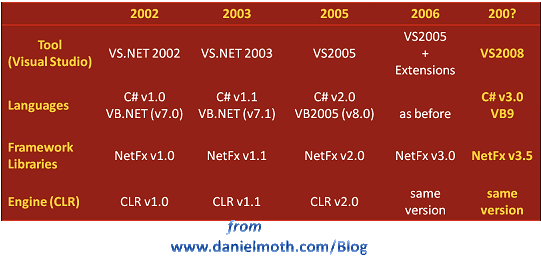
C# 3.0 features
New Language Features for C# 3.0
- var keyword - Declares a variables that will be created as the type that it is set to. This is particularly useful for LINQ, but it can also be used in foreach...
foreach(var cus in customers) // cus is strongly typed as a Customer type.
- Object initializers - Allows you to initialize an object by setting properties.
var cus = new Customer() { Name = "Boeing" };
- Collection initializers - Similar to object initializers, but used to load a collection. Any Add method exposed by the the collection can be used to define the initializer. This allows you to add elements to lists as well as dictionaries or any custom Add method that you create.
- Auto-implemented properties - Allows you to define a property without having to define the field or the get and/or set. The code is inferred by the property.
public string Name { get; set;} // this is expanded by the compiler to be a standard property with corresponding field
- Anonymous types - Allows LINQ to automatically create a type when transforming data. The type is not directly available from code, but you still get Intellisense to help you use the object.
- Lambda expressions (=> operator) - This is basically a lightweight version of anonymous methods. A lambda expression can be passed as a parameter to another method, just define a delegate that matches the lambda expression.
- Extension methods - Allows a type to "attach" methods to another type. To do this, add the this keyword in front of the first parameter in a static method.
public static string DoSomething(this string s) // This can be called like this - var something = "Hi".DoSomething()
- Partial Methods - I didn't quite catch how this works, but it seems like it allows designer generated code to define a method that you can implement.
REST - An Architectural Style, Not a Standard
REST is an acronym standing for Representational State Transfer.
Description: A representation of the resource is returned (e.g., Boeing747.html). The representation
places the client application in a state. The result of the client traversing a hyperlink in Boeing747.html
is another resource is accessed. The new representation places the client application into yet another
state. Thus, the client application changes (transfers) state with each resource
representation --> Representational State Transfer!
Tuesday, June 26, 2007

Saturday, March 31, 2007
Wednesday, February 14, 2007
Tuesday, December 05, 2006


Tuesday, October 10, 2006
XML Notepad 2006
Check this.
http://msdn.microsoft.com/library/default.asp?url=/library/en-us/dnxmlnet/html/xmlnotepad.asp
It also has a xml diff tool build in.
Tuesday, October 03, 2006


Thursday, March 09, 2006
Sunday, February 26, 2006
ASP.NET 2.0 "How do i" videos
Super high quality video series on ASP.NET 2.0 - the How Do I video series
Create a Full-Featured Customer Login Portal
Form Building for a "Contact Us" Page
Tuesday, February 21, 2006
C#: converting string into Stream
Most of the times when u deal with XML content and DataSets you might have a situation to load the XML content in string format in a DataSet and Dataset does not have any overloaded method of taking string as an parameter so this code will help you convert the string to stream which you can pass as a parameter to the DataSet.LoadXML(Stream s) method.
"string data = 'This is test data';
byte[] bytes = System.Text.Encoding.ASCII.GetBytes(data);
MemoryStream stream = new MemoryStream(bytes);"
Now "stream" contains the ascii bytes that make up the original string.
"string data = 'This is test data';
byte[] bytes = System.Text.Encoding.ASCII.GetBytes(data);
MemoryStream stream = new MemoryStream(bytes);"
Now "stream" contains the ascii bytes that make up the original string.
Subscribe to:
Posts (Atom)


